Showing posts with label Raymondl. Show all posts

Sunday, September 21, 2008

The GKA Times presents The Raymondl Interview IV

originally posted January 31, 2006
GKA:Thankyou for the long wait folks. But the final chapter of the Raymondl interview has come a close. I`d like to thank Raymondl for taking out his time every week to answer my various questions and I also hope many of you learned something along the way.
-NinjaJack


GKA:How important is the Rider Kick and bike to you?

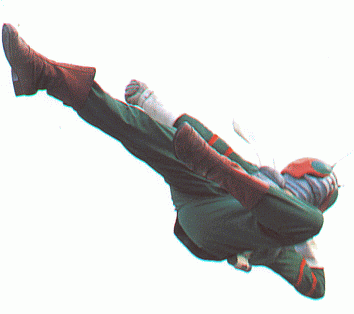
RL: The Rider Kick and motorcycle are VERY important to the whole character makeup of the franchise. The Rider Kick is the defining signature finishing move that differentiate the character from any other hero in tokusatsu. To NOT have a Rider Kick is like Spider-Man not having his web shooters or sticky powers.

The motorcycle may be either just as vital or even moreso than the Rider Kick. There is a reason he's called "Kamen RIDER" and not "Kamen WAITER" or "Kamen ROWBOATER"--the motorcycle is what gives him the "Rider" name. It's like being called "Batman" and wearing a squirrel suit--he wouldn't be "Bat-Man". No motorcycle means he's just another hero that should pick another name.
Both the Rider Kick and the motorcycle are what defines the role--if he didn't have either one of them, then he's no different than another costumed hero with a mad-on for monsters.

What makes Green Arrow "Green Arrow" is that he uses arrows that are colored green--he's not the Yellow Pole Vaulter. Kamen Rider is a masked hero who rides a motorcycle and has a kick that makes things explode. Both factors to me are incredibly vital to the whole character, and not having them demeans the heroic standard set by Ishinomori and the franchise as a whole.

GKA:The greatest and most beloved Rider of the last decade seems to be RX`s Minami Kotaro, but out of the new gen riders who would you say could give him a good sparing match?

RL: Boy, you're right--RX is not only popular, but he's pretty tough to boot! I can't say who'd give him a good match, but I'll try to see how it goes.
If you're talking about a pure fighting match, then I'd have to say Kamen Rider Kuuga--just to match the fact that both of them have more than one physical form and the fight would be about matching up each other's abilities.If you are talking about angst-ridden origins, I'd probably put Kamen Rider Gills against Minami Kotaro--they both have been given lousy breaks in life, but managed to overcome them, but Kotaro seems to have weathered it a bit better with a more optimistic outlook and he isn't so grim & gritty.
This is a tough question to answer because if I answer it any other way, your readers might take it badly if I went against RX or if I put RX over their current favorite! :)

GKA:Early thoughts on Kabuto`s look and plotline?

RL: Kamen Rider Kabuto's design is really imaginative--way moreso than RYUKI, BLADE, or HIBIKI in terms of following the insectoid design theme that 95% of the Riders use. Blade was insect-like, but mixed in too many other animal aspects while Ryuki & Hibiki didn't even try to follow Ishinomori's concept of the bug-eyed hero.Kabuto's name alone demands that he look more insect-like and he has the mix of both the classic look and the updated "super-technology" feature that KAMEN RIDER FAIZ made popular.

It's important to keep in touch with the current world, but it's also important to honor the forerunners of what came before and was successful for so long. I've said it often that Faiz was about as "radical" as I thought the franchise should get towards--it was new, yet paid homage to the classic mold. Kabuto seems to be following that path design-wise.Concept-wise, it seems to be a mix of many of the recent ideas in the Heisei Rider run.

The idea of ZECT is similar to the concept of BOARD in Blade or TAKESHI in Hibiki where an organization is created for the sole purpose of combatting an evil group--which is a decent idea. The army idea of the ZECT-Troopers supporting the Riders is a new and interesting concept so far.Still, we have to see how the show actually performs before anyone can say if the program works or not. It's a bit too early to tell right now because it usually requires at least 4 episodes to settle in the basis and objectives of the program.

GKA:Again, sorry to poke around in the rumor mill. But if it came to be, what do you think of the idea of a new Metal Hero series after Kabuto is over? And if you don`t mind me asking, ignoring my B-Fighter bias, which previous series would you like to see get a second run?

RL: Well, I normally don't like rumors (as you already stated) and all of that talk about Toei returning to the Metal Hero line after Rider is not only premature, but erroneous because KABUTO hasn't even aired 10% of their episode run yet and already people are yammering about what's coming next.

If people were that accurate, then I'd like to have them predict lottery numbers for me. Rumors only spread lies and unnecessarily builds up peoples' hopes or dashes them. Rumors only start flame wars and can be created to sound real by anyone.

I'm sure a lot of folks would believe me if I tried really hard and made up something out of my brain, but I don't do that because I hate looking like a chump when the real thing comes out and it isn't anything close to what I flapped my mouth about.Still, your question is valid because there can always be a possibility of Toei's return to the independent hero types like the Metal Hero series. It may return not to replace the Rider shows, but it could also air simultaneously with both Rider and Sentai, or it could be something completely new.

I don't think viewers should concern themselves with that idea for now and they should just enjoy what is already being presented and be pleasantly surprised when something fresh comes up.As for which hero series should get another run, I'd probably would like to see a return of the Rescue Police line. The metal suits always work well visually and the concept of the police-oriented heroes obviously worked well with the success of DEKA-RANGER, so that is always an idea I'd like to see return to the airwaves.

Just like you, I liked B-FIGHTER a lot, but not so much B-FIGHTER KABUTO because I thought the first show was so good that having a sequel just would pale in comparison to the first B-FIGHTER series. B-FIGHTER KABUTO was not up to the standards in both design, concept execution, and acting prowess as the first one was.OK--I'll finish up the rest of the interview in my next e-mail to you, hopefully by tomorrow or Monday.


GKA:The Tokusatsu market has seemingly exploded in the last three years. Shows and films like the Gran Sazer series, Garo, Ryukendo, Mirrorman Reflex, Woo and even Koreas new shows seem to have suddenly sprung up adding to the already running Ultraman, Kamen Rider and Super Sentai series. Thats alot to watch, it`s like it`s the late 70s all over again. But why?

RL:I'm glad that you and your readers have noticed the rather large influx of new tokusatsu projects out lately--it has been looking a lot like the 1970s with the proliferation of so many tokusatsu shows and movies.

Now as to why this is happening--I'll be honest...I don't have a clue. It's obvious that tokusatsu SFX has increased in quality, which would lead to a larger SFX budget, and also to hire so many performers, so it logically stands to be that tokusatsu isn't a cost-saving move for any company. It's not Hollywood with their overblown, garish SFX that overshadows the story and acting, but it's not cheap either, so any idea that tokusatsu is cheaper to make than say, an anime program, is wrong.

Might be merchandise selling? I think it may be easier to make action figures of superheroes than say PuffyAmiYumi dolls when it comes down to putting in features & accessories. A Kamen Rider Kabuto toy will do a lot more than a Sailor Moon doll in terms of lights and all kinds of gimmicks, but that certainly can't be the sole main reason why tokusatsu is so abundant these days.

The book industry also are on top of the tokusatsu trend with NEWTYPE THE LIVE and TOKUSATSU ACE, so there is a strong market for tokusatsu books and magazines, but merchandising can't be the main key.Might it be a way to find a new popular performer--to see if he or she becomes the next Shaku Yumiko or Odagiri Joh? Maybe, but there are more people in tokusatsu that don't go on to bigger and better things than there are super-successful ones, but the ones that do become really popular get really skyhigh.

Still, that's not a good enough aspect.Could it be just an influx of imagination and ideas? That's the one I might sort of lean a bit closer to for now--this year's Sentai program (Boukenja) is a new idea that hasn't been overused like the animal teams, or that there is still a goldmine of ideas from the old days that are reaching a new generation (i.e. MIRRORMAN REFLEX and the introduction of Toei Tokusatsu Channel on Japanese cable that's re-airing a lot of old tokusatsu). Even toys have begun to remarket the older heroes like Chojin BAROM-1 for Bandai's Sofubi Tamashi line or SIC doing the AKUMAIZER-3 set.

Even non-superhero stuff like YOKAI DAISENSO or AEGIS turned out to attract moviegoers and there seems to be no stopping of new versions of the main 3 franchises, so maybe it's just a good time to be creative with tokusatsu, especially with offbeat shows like GARO or SHIBUYA 15 that wouldn't have been thought up of even 5 years ago.

I really don't know the answer to why there's so much tokusatsu now, but I am glad that there is so that everyone can find a favorite and enjoy the genre rather than be pigeonholed into only watching the Sentai, Rider, or Ultra programs. With the choices of the Choseishin shows and RYUKENDO as well, it's a good time to be a tokusatsu fan. I might never know the real answer for this, but it seems that its a "mystery" that I don't need solved right now because I hope that everyone is enjoying the vast options.


GKA:Give me a list of the five most important folks in Tokusatsu history

RL:Well, it's only my personal opinion, so I can't say that it's the "be-all, end-all" choices, but here is who I think are the top 5 people in tokusatsu history (in no particular order):

#1--Ishinomori Shotaro.

Not only did he create KAMEN RIDER, he also created the Sentai franchise, put out numerous tokusatsu programs that helped fuel the genre in the 1970s during tokusatsu's "Golden Age", also devoted time to making tokusatsu programs for girls with a positive angle and attitude, and also was a proliferent manga artist & writer whose influence is still being flet today.


#2--Tsuburya Eiji

Tokusatsu didn't get a start without him, because he essentially made Japan think that tokusatsu could work because of 1954's GODZILLA. His visual creativity and imagination brought Godzilla to life and tokusatsu would have been a failure had GODZILLA not been so well done both storywise and visually. The fact that he also created ULTRAMAN and the subsequent sequels is icing on the cake.

Despite what any other creator has done, no other subjects other than ULTRAMAN and GODZILLA have sold more merchandise and have the visual recognition like these two creations have had, and that is due to Tsuburaya's efforts.#3--Tanaka Tomoyuki. While his main claim to fame is that he was the one who thought up the idea for GODZILLA, it was his writing of the script and direction of the film that brought tokusatsu to the masses as a viable entertainment option.

People forget that GODZILLA was Japan's first tokusatsu project, and if he didn't think of such a thing while being bored on a plane flight, there would be no tokusatsu at all today.#4--Kawauchi Kohan. The first man to take advantage of tokusatsu by putting some really imaginative characters on TV when television was first being sold in Japan en masse.

Japan had gotten into TV a bit later than America, and even a few years after World War 2, many families could not afford a television, so there really wasn't a lot of programs on the air. Kawauchi Kohan brought superheroes to Japanese TV with shows like GEKKO KAMEN, NANA-IRO KAMEN, ALLAH NO SEISHA, and other non-superpowered crime fighters who wore masks and defended Japan against evil and injustice.

These characters were very matinee serial styled, but by putting them on TV, he proved that tokusatsu didn't have to be a giant, irradiated monster and that the new entertainment medium could be used fof such a genre. While he didn't produce a lot of shows in general, he brought it to the masses first right in their own homes, so without Kawauchi, there'd be no tokusatsu on TV to influence viewers of that generation, which would have lead to people like us not being impressed with gaudy suited heroes fighting rubber suit wearing bad guys.

#5--A combination of three performers. Naya Goro, Izuka Shozo, and Soga Machiko. These three people put tokusatsu on the map during the 1970s, when tokusatsu had their real big run. All three played villains, and without their performances (for Naya Goro & Izuka Shozo--their voices only), both the Sentai and Rider franchises would have been perceived as a joke if their enemies weren't somewhat formidable.

The struggle between good & bad had to be believable, and since the heroes would always be written better, looked better in costumes, and always righteous, it fell upon these three performers to break out and really put a stamp on the genre by putting either a face or voice to the bad guys, and make it look good. Without these three, half of the villains of the 1970s would have not lasted in fans' memories and the genre would have not been as fondly remembered as being entertaining.

You can compare the Japanese main villains to the ones on POWER RANGERS and you can easily tell the difference between a fearsome villain that could really be a threat to the heroes, and the one that you know is hamming up the dialogue and could have been beaten back in one minute if the script didn't call for them to stick around.

It's like comparing Doctor Doom or the Riddler--who seems like they'd give your hero a run for his or her money? It's just like that with these three performers--cannon fodder types they are not.

GKA:And lastly. give us your thoughts on the Superhero. What does he stand for, why do kids love him and further more why do those kids offten hang on to these heroes long after they`ve grown up

RL:The superhero is a necessary concept for society. Every young person longs to right wrongs done to them (or at least perceived to be done to them), and the escapist fantasy of having powers is an intoxicating idea that we as people have always romanticized.

Even the most "mature" person in the world at one time or another has wished for some superpower to do incredible things.The superhero's main power should always be his or her moral & ethical nature. Kids look up to superheroes because of the concept behind them to help humanity and give aid when those less-fortunate are in trouble.

Every superhero or superheroine, no matter what their powers are, be it super-speed, have a mighty kick, fly, or able to throw fire, uses those powers not for self-motivation, but to devote their efforts & abilities to help those in need.Superheroes stay with us as adults because we are ingrained by society to always give back more than we take.

While this doesn't always hold true to everyone (i.e. supervillains or the jerk across the street), people who were brought up in any society (be it "civilized" with infrastructure, or "less civilized" with little resources) that has cultural norms & beliefs always emphasize the point of helping those who are like them in nature--their fellow human beings and other living creatures.

Superheroes take that norm one step further and have the added abilities to help those who require assistance far more spectacularly than normal people. The fantasy of gaining abilities that exceeds what life has given us further enhances the notion that once you are in the position of being able to give more help than you require from others, then it's your duty to do so selflessly and totally.

That's why I think there are no real differences between American heroes and Japanese heroes--none of them ask for anything in return because it's their intrinsic sense of duty that compels them to help the weak against those that defy society's efforts to keep their denizens happy & safe. There is no difference between Superman and Ultraman--both do the same jobs with different tools, but the goal, the motivation, and the results are the same.

We adults still care for the concept of the superhero that we learned as kids because now we know the lessons superheroes teach us--that there is a sense of obligation to see justice done for the safety of our societies, and that is an idea that never fades away.

GKA:Last word and goodbye to our readers.

RL:Well, I have to admit--I was a bit surprised in being asked to do this interview. I really don't know if I make any impact anywhere other than our board, but from what the good folks here at GKA tell me, I'm some kind of "expert" at tokusatsu & superheroes, and that people on the Net somehow know about me.

Frankly, I'm deeply flattered and a bit embarassed to be given such a nice introduction by the people here at GKA, and I should be one honored rather than them, because I never thought that I was anything more than a tokusatsu fan who paid attention and was in the right place at the right time.

I really don't think that I'm anything more special or better than any of the tokusatsu fans out there right now, so I think my job is to merely relate any information I have about tokusatsu that I've learned over the decades so that everyone can be as knowledgable as they can be about this really unique form of entertainment and art--yes, I think tokusatsu is an art form.

It has its good sides and its bad sides, and no one should ever hesitate to question tokusatsu in any aspects of it because if you spend time watching it and buying stuff related to it, you deserve the best, and if the product isn't good, then you should not watch it and go on to another one--that's the beauty of tokusatsu...there are decades of ideas out there in this field, and I'm just trying to relay to everyone that there's a whole world of information out there of this.

I'm truly grateful to GKA for even considering me a candidate for their pages--I'm no celebrity, I'm not looking to promote any program or project other than our board, and I'm certainly not getting rich from pushing tokusatsu towards people, but I only want everyone to look at a fascinating genre that seems to always be overlooked outside of Japan.

I'm just like every other fan--I just happen to pay attention and not just watch the program at face value and I looked beyond the story & SFX and I wanted to see what made these programs tick--what made them fascinating to me behind the scenes--what propelled the show outside of their scripted fantasy world.

I've been asked why tokusatsu fans find me either perplexing or unorthodox in the way I approach the genre. I think its because I never saw myself as a Japanese hero and I rarely play-acted as one because I saw them as metaphors in life rather than just people in costumes fighting alien armies.

Tokusatsu is more than just fighting heroes to me--they are mirrors of conduct. They are representations of social concepts. They are the culmination of ideas and imagination. They are just plain fun to watch if you don't take things too seriously or they are programs that elicit deep conceptual arguments if you do take them a bit further.

Anyway you slice it, I like tokusatsu, so as long as I remember that they are programs on TV & on the movie screens and only their inherent concepts should be taken in real life, not their abilities to punch out concrete walls.I am honored, I am humbled, and I am overwhelmed that GKA has chosen me as an interview candidate.

I hope to be around for a while so that I can devote more efforts into giving out information about tokusatsu, have logical conversations about the ideas they put forth, and to just enjoy them as I did as a child, and this interview made me look back a bit more introspectively at why I like this stuff so much.

Thank you GKA, and thanks to your readers for taking time out to hear someone whose not really that important in the world of tokusatsu to share his thoughts and opinions with you all. Best wishes to everyone out there and to the GKA staff, especially NinjaJack / King Kodro for all of his hard work and efforts.

I hope that as time progresses, more and more people get to watch all kinds of tokusatsu and find it just as enjoyable as anything else in their lives and pass it on to future generations as a way of sharing what they like and what they stand for.

-Raymond L

The GKA Times presents The Raymondl Interview III


originally posted January 24, 2006

GKA Times:Thanks to alot of in depth questions and insighful answers from Mr. Raymondl the Times will be forced to extend this interview for one more entry of answers from this life long fan of the heroes of henshin.

"Lets Go!-Super Sentai


GKA Times:Sentai is preparing it`s 30th anniversary, how many of these Sentai seasons have you seen? And what do you think of the early shots of the new one.

RL:That's right--not only is it Super Sentai's 30th anniversary, but also the 35th anniversary of Kamen Rider, and the 40th anniversary of Ultraman! 2006 will prove to be an exciting year for tokusatsu! How many Sentai seasons have I seen?

Um, let's see..something like...all of them. I've been watching Sentai since the very first day GO-RANGER premiered in 1975 in Japan. There was a big build-up to this new program, and all of the kids on the block ran home to watch the program. The next day, every kid I was playing with wanted to play GO-RANGER--me included! I haven't missed any seasons of Super Sentai or Kamen Rider. I've missed sporadic episodes of Ultraman, but not since 1980.

I've pretty much watched nearly every episode of every tokusatsu program on the air since 1971 either first-run in Japan or via video (or for your older readers--film reels, which is how I watched KIKAIDER for half a season). Since I haven't seen any episodes yet of BOUKENJA, I'll hold off giving it any real opinion, but I think the concept is fresh and new and not rehashed--like animals or dinosaurs. No more dinosaur or car-related Sentais, thank you very much.


GKA:Of course I have to ask this if I want an in depth interview, what do you think of the Power Rangers?


RL:Ha ha ha! I knew the POWER RANGERS question would pop up! That's quite all right--I actually have a mixed opinion on PR. I don't completely hate it like some people, and I certainly don't think it's better than Sentai--I'm grateful for it and at the same time, I don't think it's very good quality-wise.

I appreciate that PR introduced Sentai and by a vicarious extent, the world of tokusatsu to the American public. A lot of people watched PR and it sparked interest in the genre, and many people looked beyond the program to find its origins in Japanese tokusatsu and grew from there. I believe that without PR, a lot of folks would not have discovered tokusatsu and would be missing out on a great form of entertai

At the same time, I think the product that Saban originally presented could have been more faithful to its original content. As evidenced in Hawaii, tokusatsu that was either dubbed or subtitled proved to be successful with the airings in prime time of KIKAIDER. As long as the quality was entertaining, Japanese tokusatsu programs could translate here well.

I think that Saban could have made PR a bit more like Sentai and not pander down to the viewers. I realize that Saban was aiming for children, and I totally agree with Saban that the kid's audience is their primary goal, but I have a problem with the lack of quality dialogue, poor casting jobs with the inexperienced performers, and not putting any care into making believable storylines.

The inclusion of Bulk and Skull were totally unnecessary and brought down the program, which I had hoped to be more Sentai-like and not so--goofy. Now the general public thinks tokusatsu is a joke and only limited to children, and if PR didn't perpetuate that stereotype, maybe tokusatsu would gain a greater foothold in the States.

I understand that in the early stages of the program, they could not put in the budget of matching the filming styles between the American scenes and the Japanese fighting scenes, but once it got popular and profits were rolling in, Saban (and now Disney) could have put in more quality into the program plotwise and hire better actors. Now, I don't mean totally copying Sentai, but do something of equal quality but original to the American version.

A lot of people have told me that PR: TIME FORCE was one of the better ones and after watching a few episodes, it was nearly a total plot-lift off the original TIME-RANGER, one of Sentai's better entries. That's not the way to make PR better I think. I believe that the PR team could make a storyline that's original to PR that would equal the excellent storytelling in TIME-RANGER or JETMAN if they bothered to try.

I could go on, but I'm not upset at PR--I just believe that television should get better as time passes because the producers, the writers, the SFX team, etc, should have gotten the hang of it by now and not use what didn't work in the past, namely jokey scenes and poor acting.

I think the PR team should be comfortable by now to make their own stories and realize that the audience isn't so juvenile and make a good show that makes viewers care about the program and look into it more. Maybe if PR made a totally new Rangers show featuring members NOT originally from Japan, it might work.

But I'm sure Bandai wouldn't want that--they wouldn't sell more toys. I think PR & Sentai can work together, but I think PR still has a long way to go to be even half as good, but there is always potential. I will always be grateful to PR for introducing people to tokusatsu, but the consistent juvenility of the program makes the general public believe all tokusatsu is like PR, and that's not true. Maybe PR needs a shake-up that makes people talk about it again.....


GKA:And further yet, what do you think of Sentai and Power Rangers sharing their Battlizer powerup in the Magiranger vs Dekaranger teamup. Or the Rangers stunt choreographer Koichi Sakamoto filming some Magiranger Fight scenes.RL:I think the use of the American-created Battlized armor for Deka-Red in MAGI-RANGER vs. DEKA-RANGER was long overdue! Since PR uses almost everything of Sentai, why not reciprocate the deal and use one or two PR ideas in Sentai? I think all it does is make Bandai richer by selling another action figure to a new audience in Japan! I don't mind some occasional cross-usage...it's like PR took all of Sentai's baseballs home to play with, and if Sentai wants to use one of PR's footballs once in a while, that should be OK, right? Ha ha ha! As for Sakamoto filming MAGI-RANGER scenes--that's just as OK!


GKA: With a love for both American and Asian heroes you must have went nuts when you heard that Marvel comics was working with Toei on those early Super Sentai series.

RL:I didn't mind too much about Toei asking Marvel Comics to help out with Sentai. As I wrote on our board, BATTLE FEVER-J was originally not a Sentai program, but started up as CAPTAIN JAPAN, which was supposed to be similar to Captain America. When that concept didn't come through, Toei simply re-used the idea of Sentai that Ishinomori Shotaro created with "Himitsu Sentai GO-RANGER" and "JAKQ Dengekitai", so Marvel's influence on Sentai is neglible at best.

I think Marvel got the better deal out of it by importing MICROMAN and some of the Super Robots over as MICRONAUTS and SHOGUN WARRIORS, while all Toei really got was their version of SPIDER-MAN. The "CAPTAIN JAPAN" idea fell through, so I don't really consider Marvel as having any direct influence on Sentai's genesis, seeing that Ishinomori came up with the idea 4 years earlier, and all Toei did was re-hash the concept.


GKA:Do you like mecha in your hero shows?

RL:Mecha in my hero shows depends on what kind of hero we are talking about. It obviously does not work with KAMEN RIDER to a large degree (the closest success was Auto-Vajin from KAMEN RIDER FAIZ, but luckily, the robot had little airtime), and it is almost a necessity with the SUPER SENTAI line.

It did work out well for the Space Sheriff-styled shows, which "Kyozyu Tokusou JUSPION" used to brilliant effect, but then it wouldn't work with more non-super powered heroes like CONDORMAN or JIRAIYA. It would definitely be out of place with period-piece heroes like SHIROJISHI KAMEN or Henshin Ninja ARASHI, so the success factor in having mecha on hero shows depends on the hero's motif--mechanized shows like WINSPECTOR or JIBAN are already skewed towards mecha, while it would look out of place with ULTRAMAN.


GKA:From this Ninja`s point of view, Sentai has been lacking in quality Reds since GoRed. I liked Ban whenever he didn`t yell. But the current trend of reds seem to have been too hyperactive and boylike to be taken that seriously like Reds of the 80s and 90s
What do you think?


RL:Mmmm...that's a question with no real good answer. The old-fashioned, more professional-like Red Sentai leaders have been gone for a long time (since Hoshino Goro / Oh-Red in OH-RANGER), and at times there are flashes of that kind of non-hyperactive Reds (like Tatsumi Matoi / Go-Red in GO-GO FIVE and Asami Tatsuya / Time-Red in TIME-RANGER), but for the most part, today's generation of viewers have had nothing but the over-loud, hyper Reds.

You have to remember that today's tokusatsu programs are breeding grounds for upcoming young stars, both male and female, and most of them are hired to be "ikemen" or "pretty people" with little acting experience. Since the Red member is always the key focus main character of any Sentai program, they have to hire a really "attractive" guy (for the legions of older, middle-aged women who watch these shows with their kids) and that key person has to stand out--hence the over-anxious, boisterous Reds.

It's certainly not what I seek in the lead role, and sometimes, the loudness factor actually diminishes my liking for the Red member, but then I have to remember that these shows are aimed at children and that my tastes are a bit out of age demographics for these type of shows. I have no choice but to accept today's Reds that need Ritalin, but for the most part, Toei has been really careful not to make them too annoying personality-wise.

They are loud and yell too much, but overall, the Red members tend to be the most heroically written Sentai member, so that's always a saving grace. I think the days of the cool, calm, collected, and calculating Red leaders like Kaijyo Tsuyoshi / Aka-Ranger from GO-RANGER are gone because of the emphasis on hiring model-type guys rather than getting a more mature, established performer.

Toei isn't the only one guilty of this, though. Toho has consistently hired the most annoying leader-types in their "Choseishin" series, with Sazer-Tarious from GRANSAZER and Lio-Sazer from SAZER-X as being way over the top in delivering dialogue and being generally no more heroic than the other members, losing the charm that Toei has with the Red Sentai members.

"Rider Kick!"-Kamen Rider


GKA:I know you loathe rumors as opposed to hard facts, but it`s pretty widely accepted that Ishimori Shotaro was quite displeased with Saban`s Masked Rider series. What are your thoughts?

RL:I can't blame Ishinomori being upset at how Saban churned out MASKED RIDER. It's no rumor that he was livid at it--that's a cold, hard fact. The fact that not only the show was butchered to pieces storywise, Saban couldn't even keep the correct Rider and their accompanying cast intact in one show.

MASKED RIDER was supposed to be Saban's version of KAMEN RIDER BLACK RX, but to use scenes from KAMEN RIDER ZO was a bit too much, seeing that RX & ZO look the same as if you put in Jose Canseco on a TV show and used footage of Oprah Winfrey and tried to pass them off as the same person.

Ishinomori held KAMEN RIDER rather close to his vest, usually handling casting of the Riders himself and always writing the series opening episode and guideline bible for each Rider until his health gave way. By the time Toei sent out RX to Saban as MASKED RIDER, he wasn't in the best of health and to see his creation butchered was probably a major insult to him.

I think that MASKED RIDER is perhaps one of the worst-made shows ever in the history of television, because of the ridiculous scene splicing, the inability to merge the Minami Kotaro scenes with that awful kid actor, and the inclusion of that Ferby-looking thing with the multi-cultural family, just to be politically correct.

From production values, to story plotting, to continuity control, to acting performances, MASKED RIDER was awful from the moment it started, and I don't blame Ishinomori for being irate at it--it was a justifiable emotional response. I've seen better movies made in the 1950s & 1960s as drive-in monster fests that are superior to MASKED RIDER, and trust me, I've seen a lot of bad movies.

Since I don't have as much emotional attachment to the Rider character as Ishinomori, my only way of not supporting that version that Saban made was to simply not watch it, but for Ishinomori, you can't help but be mad at what someone did to your creation.

GKA:Now that Shotaro-san has passed, are the proceeding riders anything by comparision to his?


RL:I thought that after the passing of Ishinomori, Toei and his successors at Ishimori-Pro did a good job with KAMEN RIDER AGITO and KAMEN RIDER FAIZ, and they are close, but not good enough, to encapsulate the "Ishinomori formula" that ended with KAMEN RIDER KUUGA.

AGITO and FAIZ were really good on their own, but hardly up to the dramatic level of KUUGA, since Ishinomori had some hand in Kuuga's genesis, but from mid-way of the KUUGA series, astute viewers could see that it wasn't quite an Ishinomori-styled plot. Still, KUUGA is highly regarded as one of the best Rider programs ever made, and for its first run without Ishinomori, Toei did a great job with AGITO, and I think that FAIZ is about as "radical" as I'd like a Rider to be by straddling the thin line between Ishinomori-styled story concept and a new interpretation of the franchise.

Ishinomori probably wouldn't have OK'd FAIZ if he was still alive because of the heavy reliance on mechanical gimmicks, but for the most part, it was a fresh new concept that still had the classic Rider style angst in it. As for RYUKI, BLADE, and HIBIKI--well, that's another story and those strayed too far away from the initial Rider concept, but BLADE tried its best to veer back towards it, but didn't quite do the trick.

I know a lot of your readers might not like the fact that I think that RYUKI, BLADE and HIBIKI are too far-fetched from the established Rider mythos, but if you showed any of those programs to a novice watcher, they wouldn't associate those programs with the other Rider shows.

So, do I think the New Generation Riders compare to Ishinomori's vision of Rider? It depends--are we talking about AGITO, RYUKI, FAIZ, BLADE, or HIBIKI? That's when the lines of opinion get blurred. I think that AGITO & FAIZ are the closest to his idea of Rider but still new enough to introduce fresh concepts to the franchise, but they still aren't the old Riders.


GKA:Was Hibiki a bad move on Toei`s part?


RL:Was HIBIKI a bad move on Toei & Ishimori-Pro's part? Well, with their main advertising sponsor pulling out of the program early on, the head writer and some staff members getting fired, and poor ratings & toy sales, I'll let you and your readers figure that one out! :) Let's just say that if they had a chance to go back and fix things, Toei and Ishimori-Pro would probably take that opportunity in a heartbeat......


GKA:Was Hibiki the first time Toei tried to be "hip" with a Rider series?


RL:No, definitely not. HIBIKI isn't the first time any Rider show tried to be "hip"--every Rider program has tried to emulate the times they were in. The idea behind the original KAMEN RIDER being a motorcycle enthusiast was based on the era where Japan had started to make quality vehicles after decades of making inferior cars (yes, there was a time when "Made in Japan" meant shoddy construction and poor materials--hard to believe nowadays...) and there was a boom in motorcycle purchases.

KAMEN RIDER X had a lot of psychic-styled villains because of Japan's interest at the time with the paranormal and ESP concepts. KAMEN RIDER SUPER-1 drove that huge Harley Davidson bike because the American cop program "CHIPS" featuring two motorcycle-riding police officers on the Los Angeles highway patrol was popular in Japan.

KAMEN RIDER FAIZ used the cellphone and digital items in the series due to Japan's ever-growing dependency on such devices. HIBIKI wasn't trying to be "hip" per se, but tried to go "backwards" with the Japanese-centric concept with the kanji writings, the oni motifs, the fancy named weapons, but it's far from being "hip"--I think the old Japanese ideas used in HIBKI didn't attract today's Japanese kids, who are more used to Game Boys, PS2s, cellphones, and digital cameras than they are with ancient demons who use sound as weapons.

The GKA Times presents The Raymondl Interview II

originally posted January 15, 2006

GKA:We are happy to present the second half of this three part interview with Raymondl. Stick around you might learn something

GKA: Why is it that western heroes don`t seem to latch on to audiences that much anymore?
Marvel constently gives us Spider-Man, X-Men, Hulk Avengers etc but for the life of me I can`t put my finger on why the newer heroes don`t seem to captivate audiences and "stick" the way Wolverine or Green Lantern did in their time. What must a hero do to get really noticed and stay endearing at the same time?

RL:I'm not sure if its Western heroes only that don't stick in people's minds anymore. I think that Western heroes are already at their limits on what is "original". I think Alex Ross said it best in an interview I read in WIZARD that superheroes fit into a few categories that have been "pigeonholed". For instance, there is the "all-powerful, justice-seeking" type of heroes that Superman & the Martian Manhunter are prime examples of.

Then there is the "dark loner on a path of vengeance" types that Batman and the Punisher exemplify. There is the "all-beauteous, virtuous super female" types that Wonder Woman and nearly all super-heroines qualify under. The "techno" heroes like Iron Man and Steel come next. There is the "magic-based" heroes that Drs. Fate and Strange are in and to a point Green Lantern, and then there is the "kid who gets a chance to be a hero" types that Captain Marvel (Shazam) and Spider-Man fall in.

Almost every Western hero comes under one of these umbrellas--but Alex Ross put it way better than I just did. I think after reading that interview, I can see why new Western heroes don't seem to have that staying power, because it begins a "been there, done that" routine. Even the "newer" heroes like Spawn or Hellboy all fall under one of these categories. With that in mind, there really hasn't been any new hero concepts in the West other than a variation of any of these iconic types.

While it's always enjoyable to read BATMAN or THE AVENGERS, there really isn't anything new about superheroes in decades, which is why these days, I tend to stray towards the non-hero fare like 100 BULLETS, FABLES, Y--THE LAST MAN, 30 DAYS OF NIGHT, GOTHAM CENTRAL, and THE SIMPSONS for a change of pace, even though I still like reading JSA, BIRDS OF PREY, and other hero stuff. 9)


GKA:Lets take a look at todays heroes. Give us a overview of what you think of the current Anti-Hero trend.

RL:Ooooh, the touchy subject of the "anti-hero". I'm mixed about them. Some are done well, like Jesse Custer in PREACHER, or Vic Mackey on THE SHIELD program, and some are down right annoying, like how Marvel approached Venom in the late 1990s, or how Lobo devolved into a parody rather than an "anti-hero".


Their moral ambivalence certainly attracts readers, but since the line between hero and villain (to me at least) is so thin, that writers can't help but tip them over to one side or another, and most of the time, they tip towards the side of good. Wolverine was once an anti-hero, but it's clear that he is a good guy, no matter how much so-called "killings" he's done, since he never really kills anyone that is clearly a good guy like Captain America or Reed Richards. He just kills off the really evil guys.

The Punisher is another one like that--he never sets out to shoot Hawkeye or Ant-Man, but he'll take a potshot at some cruddy villain. With that in mind, the writers lose touch of the character's "anti-hero"-ness and puts them squarely on the moral side. The characters in THE AUTHORITY, whose methods are quite brutal and violent, are probably the only ones closest in my opinion of being a true "anti-hero" idea.

Their goals don't always serve in the best interests of the majority, they perform actions sometimes without dealing with the immediate consequences, yet it always turns out for the better. Perhaps the best writing of an "anti-hero" is Vic Mackey on THE SHIELD--no matter how much good he does on the streets of L.A., the show's writers always remind viewers that Vic has shot & killed a fellow cop that was investigating him, has stolen drugs to fund his actions, hidden away evidence that would incriminate him, and other dirty dealings. At the same time, his brutal methods have cleaned up the streets, made criminals fear him, and the outcome of a lot of his actions come out positively.

I don't think there is a comic out there right now that hits the "anti-hero" idea right anymore, so comic book writers have to tread that thin line between hero and villain, and taking a cue from Mackey is a start.


GKA:America's Spider-Man has enjoyed the most success in Japan, why is this and who do you think from the US would also be accepted as a brother there?

RL:I can't explain SPIDER-MAN's appeal in Japan. It might be because he's an American hero that doesn't look all-American, especially with Japan's slight xenophobia towards non-Japanese ideas. While Japan has embraced cultural icons such as Mickey Mouse, Marilyn Monroe, James Dean, Steve McQueen, and King Kong, the ideas that are "super pro U.S.A." aren't as popular, such as Superman, or Captain America, and evident in the failure of G.I. JOE there. SPIDER-MAN, I guess, is just "super-hero" enough not to have any nationalistic allegiance towards anyone at first glance.

The movies did really well in Japan, as well as having Japan's own version of Spidey in a tokusatsu program, but I think his weird look also helps. Spidey has one of comicdom's best costumes, bar none. You ask anyone who's never heard of comics before and ask him to point out who could possibly be a "Spider-Man" and most likely, that person will identify him in a group picture with little difficulty.


Perhaps that's the appeal, since the Peter Parker storyline doesn't seem to matter as much to the Japanese as the Spider-Man aspect of the character. I don't really have an answer to this one. As for an American hero that is doing well over there, BATMAN seems to be the best bet. His dark overtones, his frightening persona, his obsessiveness--all of these have been mentioned in Japan as akin to a samurai mentality, so his appeal is strong.

Otherwise, the Japanese seem to have enough heroes on their plates not to require an embracing of any U.S. hero that I currently know of, though people's tastes change and I could be wrong within days. Who knows what will be popular--there could be a craze soon for Iron Man for all I know!


GKA:Is it a good thing that America is being so influenced by Japanese heroes? Or is it bad thing that the west seems to show a lack of appreciation of it`s own heroes?

RL:I think that the influence of Japanese heroes towards American heroes is OK--up to a point. I've noticed that a lot of publishers are seeking the "manga" look, or attempt to draw their characters with exaggerated proportions similar to manga, or outright present a hero with a Japanese undertone these days.
That's OK, but not to the point where the American idea is completely buried and doesn't seem to even exist anymore. Take for instance the recent MARVEL MANGA line where they tried to draw heroes like Spidey, Iron Man, Cap, and the rest of the guys with an all-manga style. They drew Iron Man's armor almost to the point of mimicking a Japanese mecha robot, which isn't what Iron Man is. Iron Man needs to be more "man"-looking than "bulky Japanese robot with multiple boosters, swords hidden in his hips, and able to combine from all of your Mom's household appliances".

Cartoon Network is seriously guilty of this--a lot of their newer programs are so Japanese-like, that it seems they aren't even remotely American anymore, even though the property is U.S., like TEEN TITANS and that SUPER MONKEY program. While it would be nice to emulate some story ideas from Japan, or have some art styles similar to Japanese anime or Chinese manwha, someone as American-iconic as the Boy Wonder shouldn't look like he fits in with the cast of DORAEMON, at least, not too much.

I appreciate the fact that Americans are beginning to be more interested in the Eastern style of storytelling, and that they respect the appeal of the Japanese anime style. If that's the case, then simply bring over the Japanese properties uncut, and do a joint international trade where American ideas can be aired over international TV stations and books. By totally converting over to a Japanese style, American shows are losing it's visual definition.

As a kid, you could tell that BATTLE OF THE PLANETS wasn't American, and to find out more about it, it appealed more to you that it was a foreign project. As a kid, you could tell that HE-MAN AND THE MASTERS OF THE UNIVERSE was clearly an American-made idea, and you were comfortable with it. These days, even G.I. JOE--clearly an American appeal only, is drawn by Studio Gonzo in Japan for G.I. JOE: SIGMA SIX. That makes G.I. JOE less identifiable with its original theme of being American soldiers fighting for the truth, justice, and the American way.

It's good in some ways that American producers are trying something new, but they should use some common sense and incorporate those new foreign ideas into their own original projects rather than converting over so completely. It's like if the art team from Hanna-Barbera took over GUNDAM in Japan--GUNDAM would lose its national appeal & identity.


GKA:Superman or Batman?

RL:Batman--most definitely. Actually, I'd like to make a more specific version--the Bruce Timm / Paul Dini-animated series version of Batman is the best. There have been some terrible interpretations of Batman over the years, and I think the animated version is the most clear-cut, most definitive of Bob Kane's original interpretation of the character.

I like Superman, but I haven't really liked him since the old Curt Swan / Kurt Schaffenberger days in the late 1950s / early-1960s where he used to fight all kinds of weird stuff. The current Superman has too much drama outside of his Super-ness. .

Be back here next week as we conlclude this in depth interview with Raymondl

The GKA Times presents The Raymondl Interview

orginally posted January 10, 2006

GKA Times:Ladies and gentlemen I`d like to introduce to you a vital resource in the Henshin community, Raymondl.
A man with a vast knowledge of Tokusatsu and US Super Hero history, he is one of the most thorough of fans out there in any genre. It`s a true honor to take this time to interview him. Enjoy.


Raymondl:Thank you for the wonderful introduction! I don't think I deserve the praise you've heaped on me, since I think I'm just a fan who paid attention to the shows and was in the right place at the right time, so I'm more than pleased to be here at GKA! I guess you consider me some kind of authority on tokusatsu & superheroes, so I'll do my best not to disappoint you or your faithful readers!

On life

GKA Times:Over the years at TokuBBS I`ve gained a strong sense that family is important to you. In your own words how high a priority is family today.

RL:Family is incredibly important to me. It was my father that gave me my fair sense of values, because I don't try to judge anyone too harshly, I'm all for second chances, and I have no bias towards anything other than a strong moral dislike on things that are injust. It was my mother who introduced me to tokusatsu. I was not a well child, and I was constantly sick up until 4th grade, so I had a lot of time to spend at home in bed. She and her sister (my aunt) used to send me (let me rephrase that--"still" send me) the tokusatsu & manga magazines that had all of these heroes, which I was fascinated with.

I actually knew about KAMEN RIDER and ULTRAMAN before SUPERMAN & BATMAN, even though I am American by birth. It was the difference between getting a free tokusatsu book or use my allowance to buy American comics, so since I wasn't raking in big dollars, free it was! Without either one of them, I would not have been into tokusatsu and I would not have been into doing the site as fairly as possible to all, which is now at TOKUSATSU DENSETSU

I also lost a lot of family members because of cigarettes and the disease of Lupus, so I'm a big donator towards lung cancer and lupus research, as well as volunteering for any women's breast cancer fundraisers, as my mother is a cancer survivor. So, yeah--I guess family is important to me!


GKA:Where did you grow up

RL:I was born, bred, raised, and still live in New York City. My father is Chinese and my mother is Chinese-Japanese, so I drifted a lot between NYC and Yokohama, Japan during my early years, and I attended kindergarten in Japan. I also worked in the family restaurant from the ages of 13 - 19 every summer in Yokohama, so that's another family trait I owe something to--the concept of hard work and forced to learn a language in order to function properly


GKA:As a kid who or what inspired you?

RL:Hmm..who inspired me? That's a good question--obviously my parents, but I would probably also give a lot of credit to my general environment for giving me a love for cheap pop culture, and also living in NYC gives me a more "liberal" view in things and the chance to experience a lot of cultural facets in life.
To say one particular factor as being an inspiration is a bit tough to whittle down into one or two things--I just realized that trying to answer this question made me realize that I'm kind of complicated! Good question, though--something new to think about!


GKA:TokuBBS was one of the first places I stopped by when Chris Reeve died. I recall reading you had actually met him in person, could you please give the readers a look back at that meeting?

RL:Ah, Christopher Reeve--what a gentleman and a fantastic person. I was working at CNN in NYC, and there was a big political problem regarding housing for low-income persons and some actors decided to bring this problem to the public's attention at CNN for Larry King's show. Mr. Reeve arrived with Alec Baldwin, Susan Sarandon, and the late Roger Zazlow to be interviewed for the show.

While the women in my office fawned over Alec Baldwin (who wasn't as fat as he was now, since this happened around 1995-1996!), I was of course overwhelmed that Superman himself was in front of me! The other actors had some support staff with them, which made it difficult for us workers to get to them to ask if they needed anything like drinks or ask them something prior to interview time (like what questions not to ask, or if they had any camera angle preferences), but only Mr. Reeve didn't have an entourage--he simply came by himself.

He was easily approachable, didn't turn away any fans, and was in generally good spirits and laughing a lot. I was a computer technician, but I decided to ask him if he needed anything and all he wanted was a glass of water.

Even though it wasn't my job, I quickly went to get him water and when I returned, he graciously took time out to speak with me about a broad range of topics--too bad I can't quite recall what they were, because I was just simply awed at being in front of the greatest Superman actor ever. We didn't talk too much, but he spoke clearly, looked directly at me, and always had on a smile.

I totally forgot to ask him for an autograph or to take a picture with him, but I remember shaking his hand and told him that he really made me believe that he was a real-life superhero, especially since he was here fighting for a good cause. We didn't speak anymore afterwards, but i came away with a deep admiration for him because of his genial nature, his obvious appreciation for a fan like myself, and was radiating a good vibe that made everyone around him happy.

Everyone in the office started calling me the Asian Jimmy Olsen because I guess it was too obvious that I was hanging onto Mr. Reeve's every word. A month or two later, Mr. Reeve suffered his crippling injury, and it was a shock to all of us in the office, as Mr. Reeve made a deep impact on other workers there, and we were all generally sad that it happened to such a kind and decent human being.

As you all know, he went on to fight a long and courageous fight for spinal paralysis research and inspired so many others. I wasn't surprised though, because for the few minutes I spent with him, he certainly was the Man of Steel on and off screen.


GKA:Whats your hobby?

RL:My hobbies are very varied: I collect tokusatsu & anime programs, tokusatsu & anime books, tokusatsu & anime toys, DC comics, I play middle infield for an over-30 softball league, I play on a bowling league, I read books at rapid speed, I draw comics covers, I build plastic GUNDAM models, I watch movies, I go eat out at fancy restaurants a lot, I hang out at jazz clubs, I sell tokusatsu toys on the side, I watch baseball & football, I buy CDs a lot, and I coach a women's volleyball team once in a while if they need help. Oh yeah, I also help run the Tokusatsu Densetsu site! That's just a Tuesday for me!....:)


On Comics

GKA:Now you have a black belt in comics I hear, tell us more about your love afair with superheroes.

RL:I'm pretty critical about American comic books. I grew up the only kid on the block liking DC Comics when everyone was into Marvel. I've only collected Marvel in the 1970s--mainly AVENGERS and G.I. JOE: A REAL AMERICAN HERO in the 1980s-1990s. Other than a sporadic run with the FANTASTIC FOUR in the 1970s, I've primarily read DC Comics all the way through.

Because I was there "pre-Crisis", I remember all of the various Earths, the myriad versions of kryptonite, the Legion of Super-Pets, how the Justice Society of America came to team up annually with the Justice League of America, all of the crazy WW2 heroes like the Haunted Tank and Viking Commando, the spacefarers like Space Cabbie and Ultra the Multi-Alien, and every other DC guy in between.

I was always fascinated with DC's heroes because I didn't want all that angst in Marvel books, which seemed to be a prerequisite for all of their heroes. I like my heroes a bit more pure because it is of course fantasy, and if I wanted "real life", I'd watch the news rather than read a comic book where a Martian can stand alongside an Element Man.

I'm pretty much a fountain of cheesy, useless knowledge on DC guys, especially the B-list guys who are still great to me, like the Martian Manhunter (who finally got some PR thanks to JLU), Metamorpho, Black Canary, Doctor Fate, Starfire, Power Girl, and Deadman. I think I'm one of the only bozos around who know off the top of his head that the original Green Lantern Alan Scott's middle name is "Wellington". I'm a sucker for classic DC guys, and I love what they are doing at DC now with INFINITE CRISIS and ONE YEAR LATER.


GKA:Every nation has it`s heroes, which has the best and the most heroic, Japan or the United States?

RL:I don't think either Japan or the U.S. has a foothold on each other when it comes down to superheroes. American superheroes are a different breed than Japanese ones.
Although a lot of folks compare SUPERMAN to ULTRAMAN, and BATMAN to KAMEN RIDER, I think its more about the similar archetypes of the "all-powerful" hero and the "loner on a crusade" motif rather than an actual direct coorelation.

Both countries have done admirably well with their heroes, and both sets of heroes probably wouldn't function well if their locations changed. SUPERMAN probably would have a more difficult time with the giant monsters, ULTRAMAN would probably not work well against the hidden crime in Metropolis.